

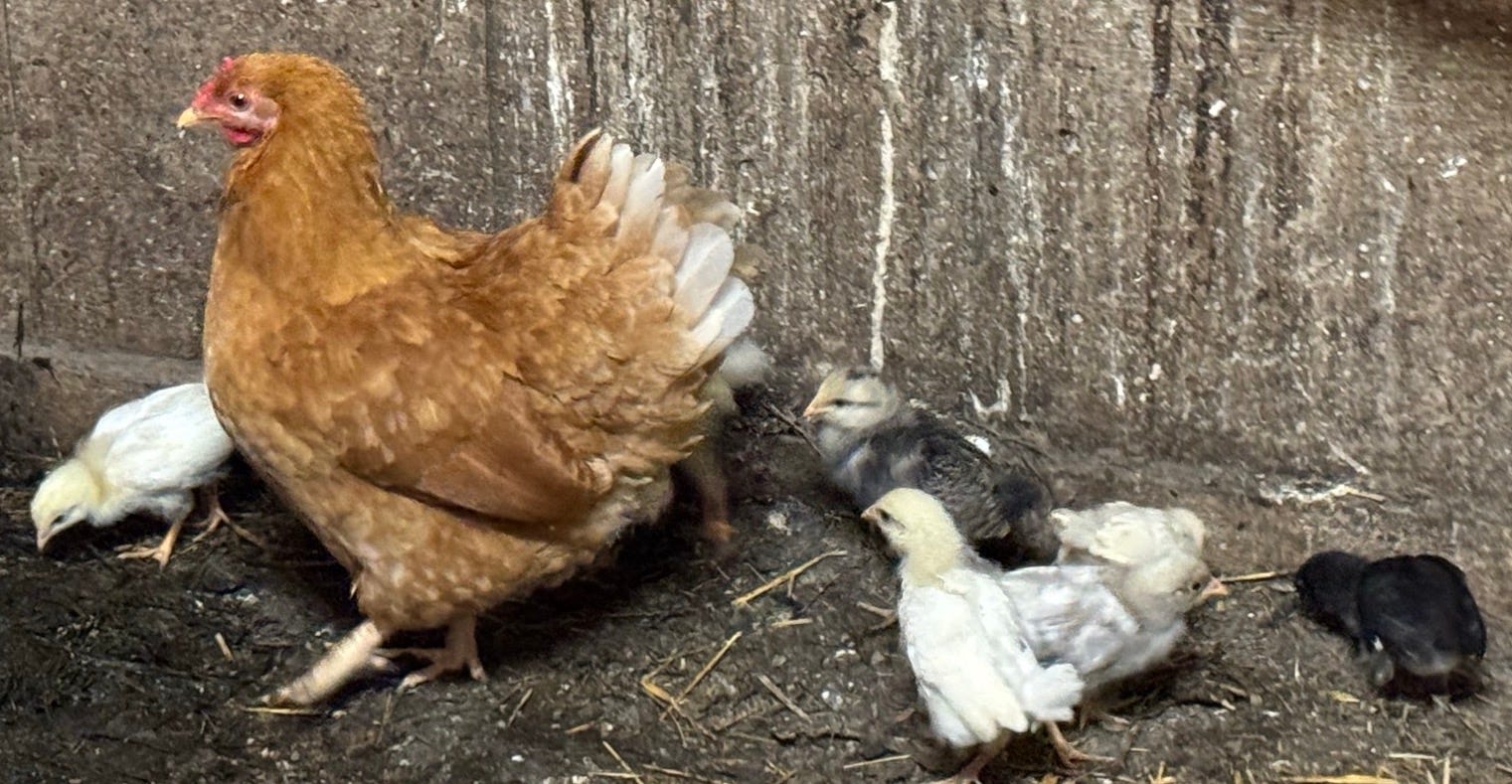
Before a hen goes broody, you should know if she is going to be a good momma. Unfortunately, that means you have to let her go broody to find out. A good brooder will sit on her eggs for about 21 days, hatch them, and care for the chicks after they hatch. A bad brooder will sit on the eggs and kill any babies that are born. If you find out your hen is not a good momma, DO NOT let her go broody! This means when the hen starts showing signs of going broody, you take the eggs she is sitting on. Warning, when taking her eggs, she might peck at you.
Signs Of A Broody Hen
The signs of a broody hen are straightforward. A hen will start to sit on multiple eggs, only getting off for food and water. They stay in the coop and do not venture outside. I start to notice the hens staying inside during the day. Then I pay attention to whether the hen is in the laying box at night or on the roost. If she is sitting on eggs in the laying box overnight, this is a good indication that the hen is broody.
At this point, we usually move the hen to her own area inside the coop. You do not have to move your broody hen from the box they are laying in if they have protection from the other hens. We always move our broody hen into a smaller coop inside our large coop. This allows the hen to be with the flock, but protects her and her eggs from the other hens. Sometimes the other hens will pick on her, try kicking her off her nest, add more eggs to her nest, or steal eggs. We like to place our brooder’s coop on the floor. Our laying boxes are elevated; therefore, when chicks are born, they could fall out of the box.
Moving Your Brooder
When moving broody hens, make sure to do it at night. We put straw in the enclosed area with a smaller dish of food and water. Next, one of us picks up our broody hen, yes, she does peck at you. The other collected the eggs under her and puts them in her nesting box. Then she is placed back on her eggs. She will move the eggs to where she feels the safest in the new coop.
Let Nature Be Nature
As my mom always says, “Let nature be nature”. When a hen goes broody, she takes care of the eggs. She rotates them, she keeps them warm, and the humidity of the eggs are perfect. The only thing we do is make sure her coop is clean and give her fresh food and water every few days. I am not constantly checking on the eggs to make sure they are at the correct temperature and humidity. Sometimes, the broody hen will eat an egg or two under her. Don’t be alarmed; these eggs are not developed and it is nutrients for the momma hen.
When hens go broody, they only get up to eat and drink. This means they poop on the eggs and sit in their poop. Gross! Right?! It does smell and it is gross, but that is part of nature and part of letting a hen incubate eggs.
Once the hen starts hatching her eggs, the momma hen will keep the chicks under her wings to keep them safe. In the first few days, they will not go far from the momma hen. If she is a good momma, she will protect her chicks and keep them warm at night.
This is very important. If the momma hen takes good care of her chicks, we will let her go broody. If she turns out to be a bad momma, we will take the eggs from her. You don’t want to let a hen sit on eggs for 21 days and then kill her chicks. Yes, it happens.
After all the chicks have hatched out, the momma hen will stay close to her chicks in the coop, but will allow them to be adventurous. At this point, any eggs that are left in the nest are no good. We clean the nesting box and throw any unhatched eggs in the woods. Be aware that these eggs might make a popping noise and smell when you discard them into the woods. This is also normal.
Depending on the flock, we will allow the chicks and momma to be with the rest of the flock. Other times, we take the chicks inside until they can go into their own coop. In the summer, we are more willing to leave them with the momma hen. In the colder months, we bring them inside under a heat lamp. Sometimes chicks like to wander away and freeze. This is what works for us, but every homestead is different.
What is your experience with a broody hen and hatching out baby chicks?
Welcome to Our Wild Journey – Homesteading with Little Feet, Big Dreams, and Endless Love!
Makalia